

Why Does AI Feel Like It's Moving Too Fast? Lessons from 150 Years of Tech Revolutions

It's July 2026, and I can't shake this feeling that I'm falling behind.
Every morning, my news feed brings another headline: a new AI model, another billion-dollar funding round, a fresh wave of automation reshaping an industry I thought was safe. My colleagues are experimenting with AI agents. My competitors are cutting costs with generative AI. And here I am, still trying to figure out which tools are worth the hype.
If you're feeling this too — that gnawing sense of FOMO, the anxiety of not moving fast enough, the fear that the train is leaving without you — I want you to know something: you're not alone. And more importantly, this feeling is not new.
Every generation that has lived through a true technological revolution has felt exactly what you're feeling right now. The speed. The chaos. The overwhelming sense that the world is being rewritten faster than anyone can absorb. In 1882, when Thomas Edison flipped the switch on Pearl Street Station, people didn't calmly adapt to electricity. They were terrified. In 1995, when the internet started penetrating households, established businesses dismissed it as a fad — right up until the moment it disrupted them.
We are standing at one of those historical crossroads right now. And if history teaches us anything, it's that the noise you're hearing — the breathless pace of change — is not a bug. It's the signal. This is what revolutions sound like.
The Electricity Revolution: 1880s–1940s
To understand AI, we must first understand electricity — because the parallels are astonishing.
On September 4, 1882, Thomas Edison illuminated the first commercial electric power system at 257 Pearl Street in Lower Manhattan. It initially powered approximately 85 customers with 400 lamps. Within two years, the station served 508 customers with 10,164 lamps. But here's what most people miss: the journey from that first switch to widespread adoption took over six decades.
The 'War of Currents' between Edison's direct current and Westinghouse's alternating current raged through the 1890s. Factory electrification began in earnest in the 1900s, but rural America waited until the 1930s New Deal programs. It wasn't until the 1940s that electricity reached near-universal adoption in the United States.
The most important lesson from electricity comes from what economists call the 'productivity paradox.' When factories first replaced steam engines with electric motors, productivity barely improved. Why? Because they kept the same factory layout — the machines were arranged around a central steam shaft, and electric motors were simply dropped in as replacements. It took 30 years for manufacturers to realize that electric power enabled an entirely new architecture: spreading machines across the factory floor, organizing workflow around the product rather than the power source.
Only when buildings were redesigned around electric power did factory productivity surge by 50% to 100%. The technology alone was not enough. The organizational transformation was the real revolution.

- 1882
Edison's Pearl Street Station opens in Manhattan
- 1890s
War of Currents: AC vs DC
- 1900s
Factory electrification begins
- 1930s
Rural electrification (New Deal)
- 1940s
Near-universal US adoption
It took 40+ years for electricity to reach 50% of US households. Factory productivity only surged when buildings were redesigned around electric power — not when they simply swapped steam engines for electric motors.
The Computer & Internet Revolution: 1980s–2010s
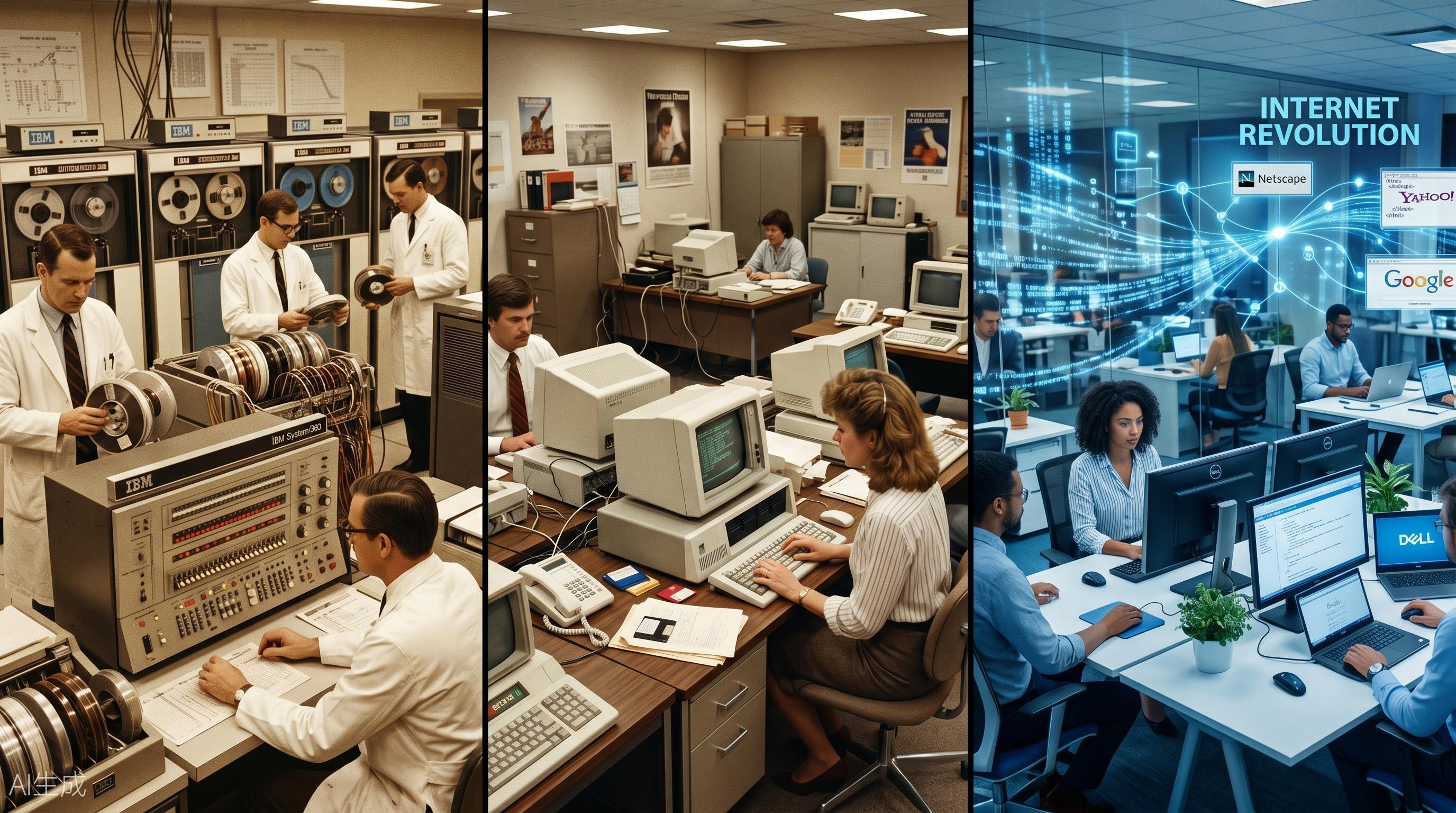
The second great general-purpose technology revolution began in 1946 with ENIAC, the first electronic general-purpose computer. But it was the microprocessor that changed everything. Intel's 4004 chip in 1971 put computing power on a single silicon die. Ten years later, in 1981, IBM launched the Personal Computer — and the revolution truly began.
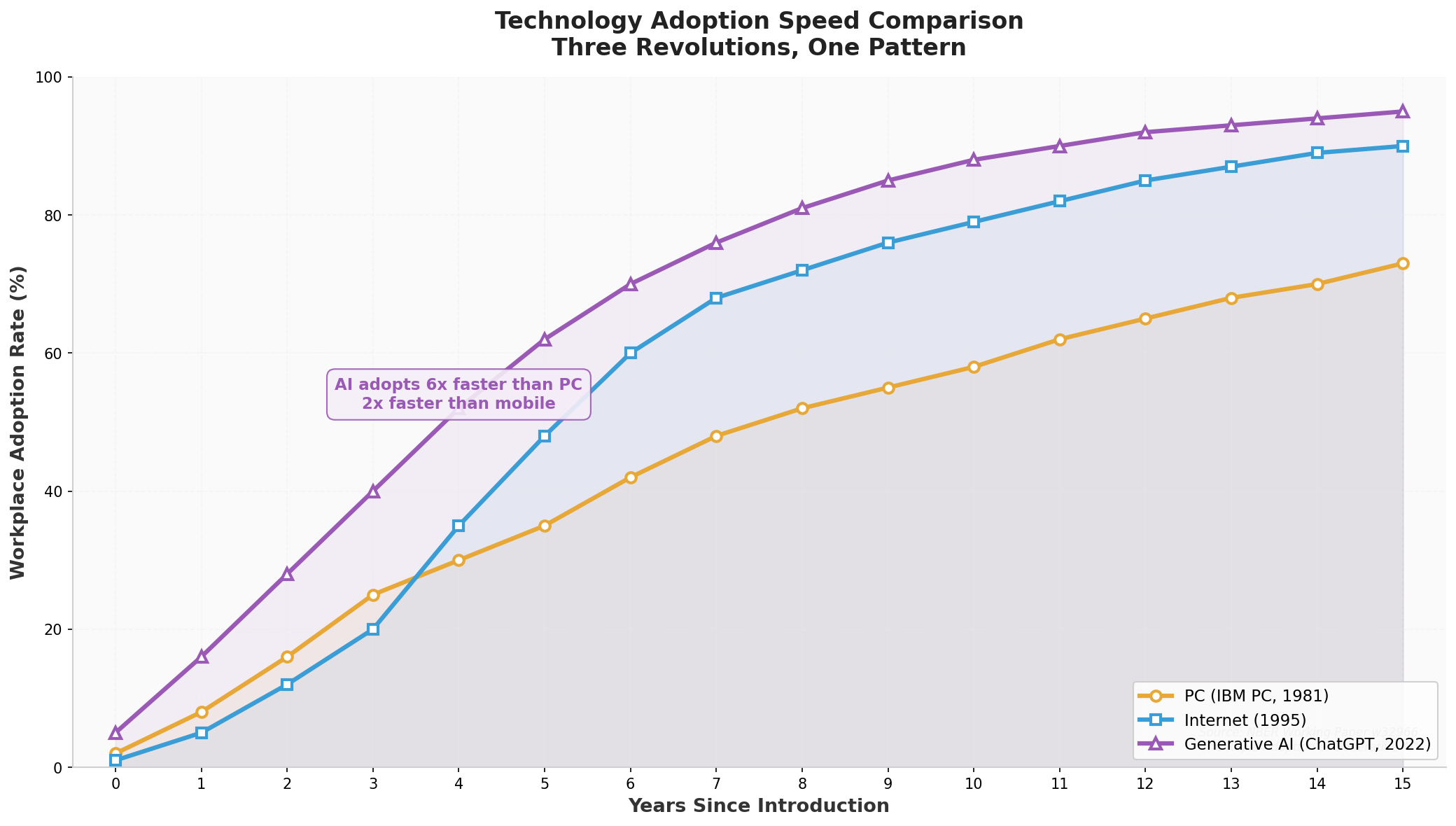
According to NBER working paper w32966, the PC reached 25% workplace adoption by Year 3. By Year 10, it was ubiquitous in offices across the developed world. But adoption alone didn't drive productivity.
In 1987, economist Robert Solow famously quipped: 'You can see the computer age everywhere but in the productivity statistics.' This became known as the Solow Paradox. Companies were buying computers — but they weren't changing how they worked. They simply replaced typewriters with word processors and filing cabinets with databases. The workflows remained the same.
The real transformation came with the internet. Tim Berners-Lee invented the World Wide Web in 1989. Commercial internet access arrived in 1995. The internet reached 20% household penetration by Year 2 and 60% by Year 7 — a stunning acceleration compared to previous technologies. But even then, productivity gains were slow until companies redesigned their processes around the new connectivity.
The pattern repeated: technology installation came first, organizational redesign followed decades later, and only then did productivity surge. The PC revolution taught us that giving people new tools without rethinking their work is like giving a painter a faster brush and expecting a masterpiece.
IBM PC (1981) → 25% workplace adoption by Year 3. Internet: 20% at Year 2, 60% at Year 7. Solow Paradox: computers everywhere but not in productivity statistics — until the internet and workflow redesign.
Three Revolutions Compared
Each cycle halves the time to 50% household penetration.
The AI Revolution: 2022–2026
We are now living through the third great general-purpose technology revolution. It began quietly — decades of AI research in academic labs — but erupted into public consciousness on November 30, 2022, when OpenAI released ChatGPT. Within two months, it became the fastest-growing consumer application in history at that time, reaching 100 million users.
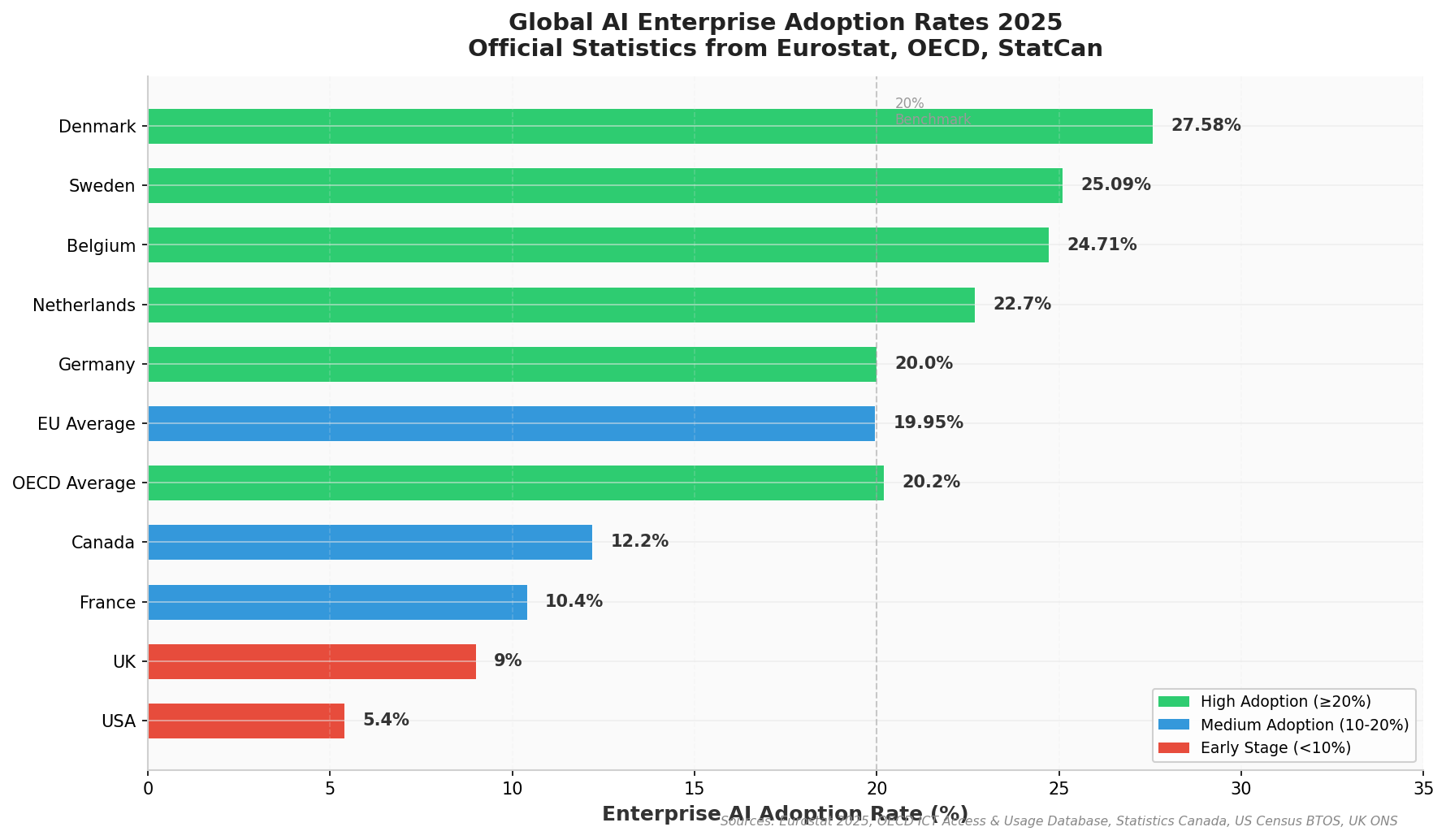
The numbers since then have been staggering. According to Eurostat, approximately 20% of EU enterprises had adopted AI by 2025. The OECD reports 20.2% of firms across member countries had adopted AI by 2025, up from just 8.7% in 2023 — a 132% increase in just two years.
But the headline numbers hide a critical reality: adoption is not the same as value capture. According to BCG research, only about 25% of companies that have adopted AI have captured significant value from it. The other 75% are in what we might call the 'installation phase' — they've bought the tools, but haven't restructured their organizations to benefit from them.
The global picture is also uneven. Denmark leads with 42.0% enterprise adoption, followed by Sweden at 35.0%, Belgium at 34.5%, and Germany at 26.0%. Canada stands at 12.2%, the UK at 9%, and the United States at just 5.4%. These disparities reflect not just technological readiness but also regulatory environments, digital infrastructure, and cultural attitudes toward automation.
What's Really Blocking AI Adoption?
Here's the finding that should change how every executive thinks about AI: the number one barrier to adoption is not technical. It's organizational.
A comprehensive 2026 study by Deloitte and the University of Hong Kong surveyed executives across industries and found that 45% believe AI has fallen short of expectations in their organizations. But when asked why, the answers reveal a pattern that mirrors every previous technology revolution.
Organizational barriers are cited by 50% of respondents — more than execution challenges (47%) and significantly more than technical limitations (39%). The top specific barriers: siloed departments preventing cross-functional collaboration (33%), lack of quick wins to build momentum (32%), and poor data quality (31%).
The size gap is equally telling. Large enterprises have a 55.03% AI adoption rate, while medium firms sit at 30.36% and small enterprises at just 17% — a staggering 38 percentage point gap between large and small businesses. This isn't because small businesses lack ambition. It's because they lack the resources to invest in complementary infrastructure: data pipelines, change management, employee training, and workflow redesign.
The ROI paradox compounds the problem. According to the Writer 2026 Enterprise AI Adoption Survey, 79% of organizations face AI adoption challenges, and only 29% see significant ROI. Even more striking: 75% of executives admit their AI strategy is 'more for show than for real value.' Yet amid this gloom, a bright spot emerges — AI 'super-users' (employees who deeply integrate AI into their workflows) deliver 5x productivity gains compared to their peers.
The message is clear: the technology works. The barrier is how organizations implement it.
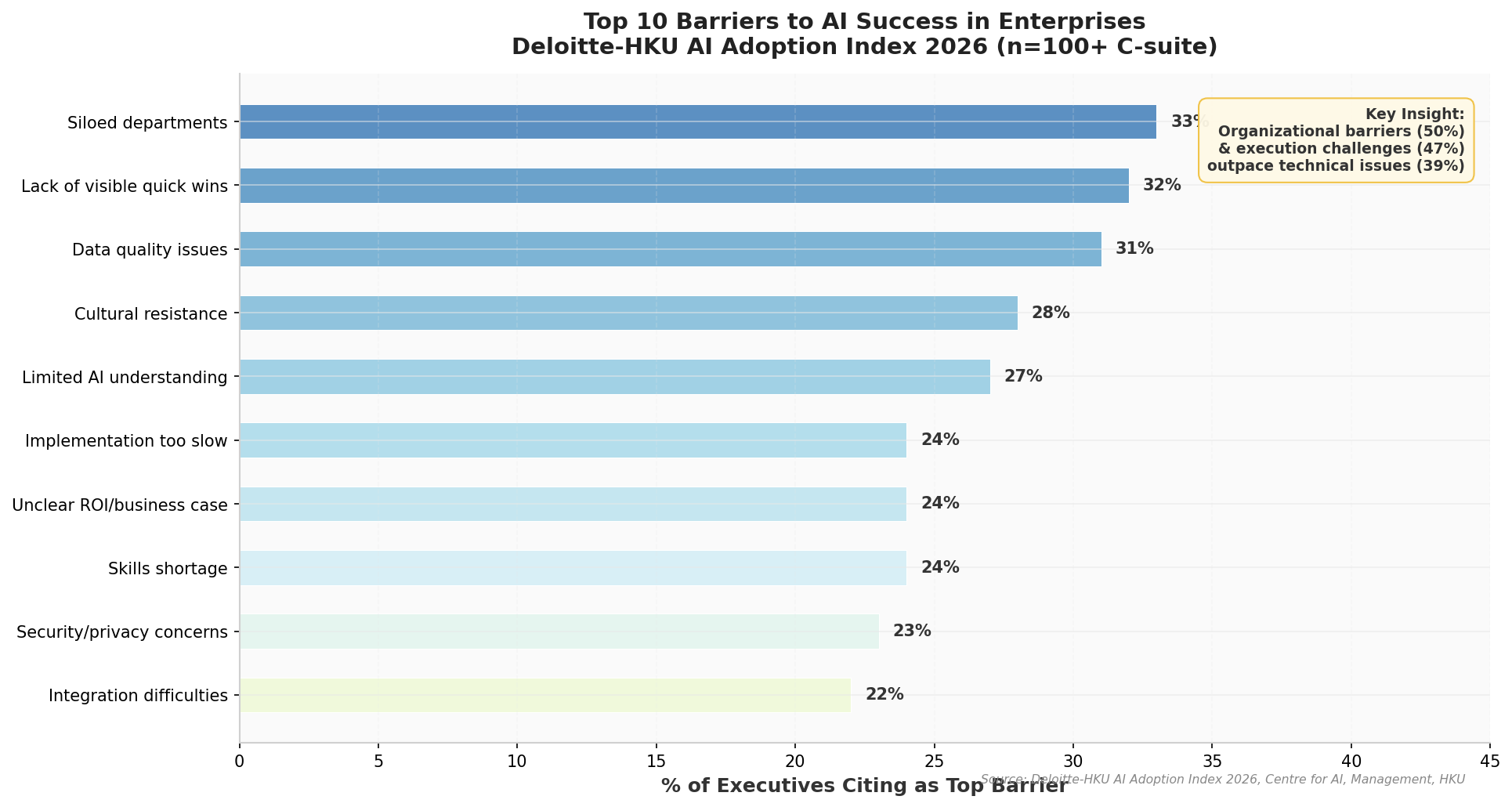
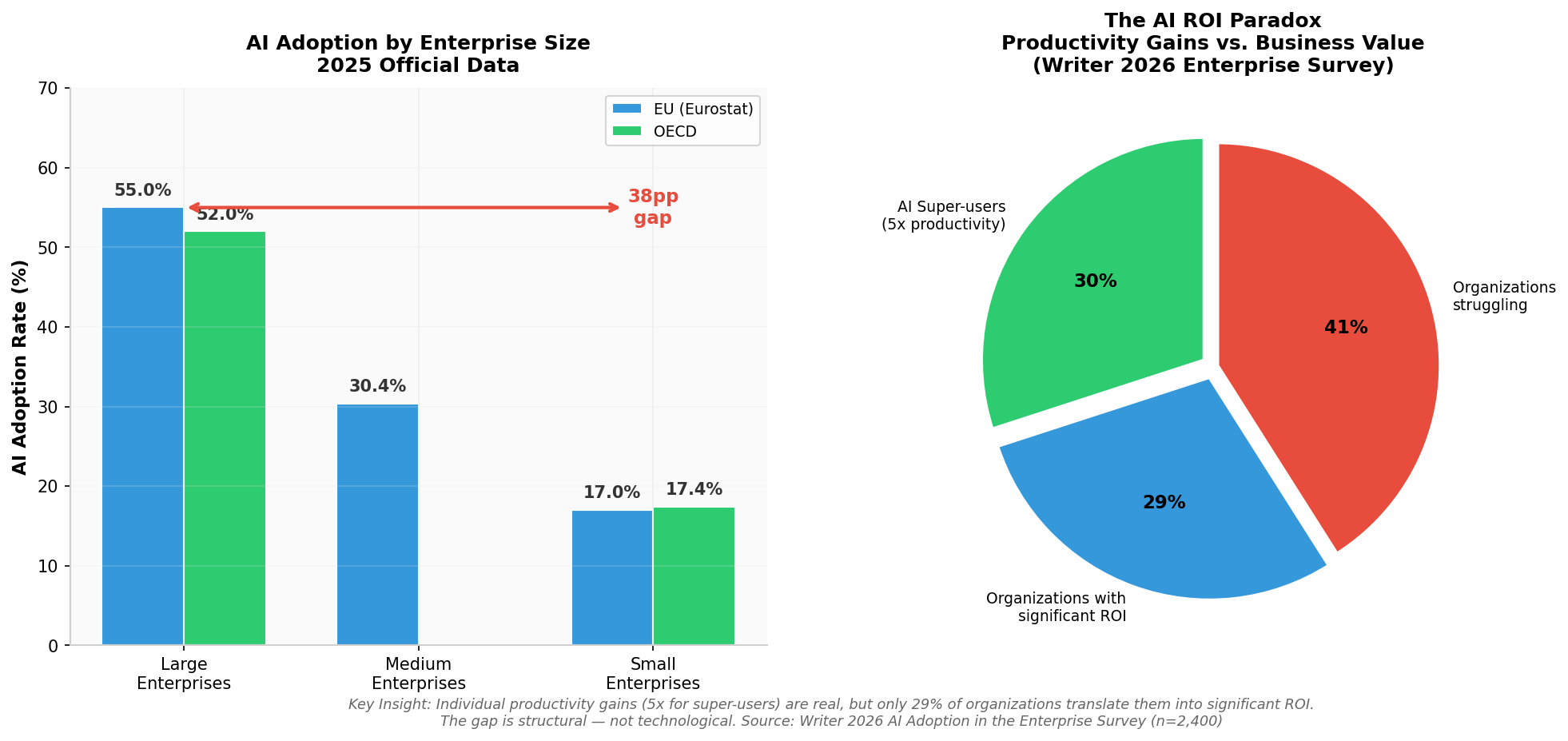

The #1 barrier isn't technical — it's organizational. 50% cite organizational hurdles vs 39% technical limitations. AI super-users deliver 5x productivity gains, yet only 29% of organizations see significant ROI.
Among Australian SMEs in 2026, trust was the dominant barrier (65%), followed by perceived lack of relevance (54%) and simply not knowing how to begin (19%). These numbers highlight a critical insight: for many businesses, AI isn't failing because of the technology — it's failing because of communication, education, and change management.
Five Lessons from 150 Years of Technology Revolutions
What electricity, computers, and AI can teach us about navigating change.
The J-Curve is Real
Every major technology revolution follows a J-shaped trajectory: initial high investment and low visible returns, followed by a sharp upward inflection point. Electricity took 30 years to show productivity gains. The PC took 20. AI will follow the same curve — early disappointment is not a sign of failure, but a predictable phase of the adoption cycle. The organizations that understand this will invest through the dip. The ones that panic and pull back will miss the inflection point.
Infrastructure Precedes Impact
Electricity needed power grids. The PC needed networks and software ecosystems. AI needs data infrastructure, model serving capabilities, and integration layers. Each revolution required massive complementary investment before the technology could deliver on its promise. Organizations that treat AI as a software purchase rather than an infrastructure investment are setting themselves up for the productivity paradox.
Organizational Redesign > Technology Installation
The single most consistent pattern across 150 years of technological change is this: the organizations that win are not the ones with the best tools. They are the ones that redesign their workflows, organizational structures, and business models around the new capabilities. AI is not a faster horse — it's an automobile. You don't need better stables; you need roads, traffic rules, and a new conception of transportation.
Trust is the Ultimate Enabler
The Australian SME data tells a profound story: 65% of businesses cite trust as their primary barrier to AI adoption. This isn't about algorithmic accuracy; it's about human confidence. History shows that technologies succeed when they become invisible and trusted — when people stop thinking about the electricity and start thinking about what it powers. Building trust through transparency, explainability, and human-in-the-loop design is not a nice-to-have. It's the foundation of adoption.
Focus on Workflow, Not Tools
The 5x productivity gains from AI 'super-users' come not from using more AI tools, but from deeply integrating AI into existing workflows. The pattern from electricity is instructive: productivity surged not when factories got electric motors, but when they redesigned the entire production flow around electric power. Start with the work, not the technology. Ask: what is the job to be done? Then ask: how can AI help do it better?
A Strategic Playbook for Enterprises
Five actionable steps based on historical evidence.
Start with Quick Wins
Every successful technology adoption story begins with visible, measurable success within the first 90 days. Identify processes where AI can deliver clear, immediate value — customer support triage, document summarization, code review assistance. These quick wins serve a strategic purpose: they build organizational confidence, demonstrate ROI to stakeholders, and create internal champions who will advocate for deeper integration. History shows that revolutions don't start with grand strategy — they start with proof points.
Break Down Data Silos
The #3 barrier to AI success is data quality (31% of executives), and the #1 organizational barrier is siloed departments (33%). These two problems are deeply connected. AI systems need access to clean, integrated data across the organization. Enterprises should invest in unified data platforms, cross-functional data governance, and APIs that allow AI systems to draw from multiple sources. The companies that win with AI will be the ones that fix their data architecture first.
Redesign Workflows Around AI
This is the most important — and most neglected — step. Don't add AI to existing processes. Redesign the processes around AI's capabilities. If you're using AI for content generation, don't just speed up your current writing process. Rethink the entire content lifecycle: ideation, creation, review, distribution, and measurement. The 5x productivity gains come from workflow redesign, not tool adoption. Hire process engineers alongside data scientists.
Build Trust Through Transparency
With 65% of SMEs citing trust as their top barrier, enterprises must make AI explainability a core requirement, not an afterthought. Implement human-in-the-loop systems where AI makes recommendations but humans make final decisions. Document how AI systems work, what data they use, and what their limitations are. Create feedback mechanisms where employees can report concerns and see them addressed. Trust is built through consistent, transparent behavior over time.
Invest in Complementary Skills
The electricity revolution didn't just need electrical engineers — it needed architects who understood how to design buildings around electric light and power. The AI revolution doesn't just need ML engineers — it needs change managers, process designers, AI-literate managers, and employees who know how to collaborate with intelligent systems. Research consistently shows that change management investment correlates more strongly with AI success than model training investment.
Conclusion
If you take one thing from this article, let it be this: the noise is the signal.
Every revolution felt like chaos to those living through it. In 1882, the War of Currents seemed like a battle between incompatible visions of the future. In 1995, the internet looked like a toy for academics and hobbyists. In 2026, AI feels like a runaway train — exciting for some, terrifying for others, incomprehensible to most.
But the pattern is always the same. The technology arrives. The hype builds. The disappointment follows. The infrastructure gets built. The organizations adapt. And then, decades after the first spark, the productivity arrives — not as a gentle curve, but as a sudden surge that leaves the late adopters scrambling to catch up.
We are somewhere between the disappointment and the infrastructure phase of the AI revolution. The organizations that understand this — that invest in complementary infrastructure, redesign their workflows, build trust, and focus on people rather than tools — will be the ones riding the surge when it comes.
The winners weren't the ones who chased every new tool — they were the ones who understood the deeper pattern.
The winners won't be the ones who chased every new model release, who pivoted their entire strategy every time a new tool hit the market, who treated AI like a magic wand that would solve all their problems. The winners will be the ones who understood the deeper pattern — who saw the J-curve for what it is, who invested through the dip, who built the roads while everyone else was still arguing about whether automobiles would ever replace horses.
The revolution is not coming. It's here. And it's moving exactly as fast as it should.
Sources & References
- Edison Tech Center. 'New York City Historic Power Plants.' Historical Archive. https://edisontechcenter.org/NYC.html
- David, P. A. (1990). 'The Dynamo and the Computer: An Historical Perspective on the Modern Productivity Paradox.' American Economic Review, 80(2), 355-361.
- NBER Working Paper w32966. 'The Rapid Adoption of Generative AI.' Alexander Bick, Adam Blandin, and David J. Deming. National Bureau of Economic Research, 2024.
- Eurostat. 'Use of artificial intelligence in enterprises.' European Commission, 2025. https://ec.europa.eu/eurostat/statistics-explained/index.php?title=Use_of_artificial_intelligence_in_enterprises
- OECD.AI Policy Observatory. 'AI Adoption in Enterprises.' Organisation for Economic Co-operation and Development, 2025. https://oecd.ai/en/data-and-analysis/ai-adoption-in-enterprises
- Boston Consulting Group. 'From Potential to Profit: Closing the AI Impact Gap.' BCG AI Radar, 2025.
- Deloitte & University of Hong Kong. 'The State of AI Adoption 2026: Bridging the Gap Between Promise and Reality.' Deloitte-HKU AI Study, 2026.
- Australian Government, Department of Industry, Science and Resources. 'AI Adopt Program: SME Barriers to AI Adoption.' Australian SME AI Survey, 2026.
- Brynjolfsson, E., & McAfee, A. (2014). 'The Second Machine Age.' W. W. Norton & Company.
- Solow, R. M. (1987). 'We'd Better Watch Out.' New York Times Book Review, July 12, 1987.
- Writer. 'Enterprise AI Adoption in 2026: Why 79% Face Challenges Despite High Investment.' Writer 2026 Enterprise AI Adoption Survey, April 2026. https://writer.com/blog/enterprise-ai-adoption-2026/